
It said it was only after the announcement that the Bush administration began briefing members of Congress and in the process created lasting problems.

US President Donald Trump warned that the United States is prepared to launch a military strike on Iran if peace negotiations in Islamabad fail, while Vice President JD Vance departed for talks in Pakistan.

Trump said the prime minister of Pakistan, who visited him in Washington last year, said that "'President Trump saved 10 million people, and maybe much more than that'. They're both nuclear countries."
At a time when the global nuclear industry is somewhat dormant, India's ambitious plans to increase power generation capacity substantially through the nuclear route has come as a shot in the arm for nuclear suppliers who are looking for big money and to revive their industry.
A top Bush Administration official has expressed hope that the civil nuclear deal with India will be done and that the Americans, in about twenty years, would be able to look at India as being one of its two or three most important partners.
He said Musharraf brought up the issue of Pakistan's energy needs during their talks and added the US Energy Secretary Samuel Bodman would be visiting Pakistan soon for discussions
The crucial civil nuclear cooperation will be high on the agenda of Prime Minister Manmohan Singh during his 10-day visit to the United States and France, which begins on Monday.The prime minister will attend the 63rd session of the United Nations General Assembly, where he would pitch for collective and multilateral approaches to deal with global challenges like food and energy crises and terrorism.

There are enough people at the top decision-making level in Tehran who are still willing to negotiate, provided Trump can create the right setting for the negotiation to acquire a dynamic of its own, points out Ambassador M K Bhadrakumar.
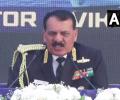
India is strengthening the naval component of its nuclear triad with Navy Chief Admiral Dinesh K Tripathi on Tuesday saying that the third indigenous nuclear-powered submarine 'Aridaman' will be commissioned soon and that his force is focusing on boosting its overall combat prowess.
Samajwadi Party General Secretary and MP Shahid Siddiqui speaks on his party's relations with the Congress, the Indo-US nuclear deal and Muslim votes.

US President Donald Trump on Sunday expressed confidence that Tehran would eventually concede to American demands, while simultaneously issuing a stern warning regarding the potential for total military devastation.

Karex, the Malaysian company that makes roughly one in five of the world's condoms -- about five billion a year, supplying Durex and Trojan among others -- announced this week that it is raising prices by up to 30 percent. The reason is the Strait of Hormuz.

Facing escalating threats from the US, Iran is mobilizing its citizens to form 'human chains' around power plants as a defensive measure against potential airstrikes, raising concerns about international law and civilian safety.
The India-Japan civil nuclear deal might not fructify anytime too soon, with Prime Minister Manmohan Singh acknowledging that India was keenly aware of Japanese sensitivities on the matter and "would not like to force the issue".Dr Singh was addressing a business luncheon attended by top leaders of business and industry from India and Japan in Tokyo on Monday.

The question is whether the clocks allow enough time for two deeply mistrustful sides to get there, and whether the surface calm holds long enough for the paddling to produce something before the ceasefire ends on April 22, notes Prem Panicker in his must read blog on the Iran War.

Iran was the chance to arrange a concert of nations, to actually be a Vishwaguru. Instead, we are watching from the sidelines as Pakistan, the same country that is apparently still at war with Afghanistan, hosts talks between US-Israel and Iran. The irony is hard to miss, points out Amberish K Diwanji.

Both sides have now revealed a preference for escalation over strategic defeat, and each new provocation narrows the space for the next pause. The Touska seizure, Iran's refusal to negotiate under blockade, Israel's strikes on Iranian oil infrastructure -- all of these add up to an increasingly untenable situation. This makes the wild card -- Trump and his motormouth -- more consequential than ever, notes Prem Panicker in his must read blog on the Iran War.
Already India is a global leader in high technology. The nuclear deal will end India's nuclear isolation and enable India to become a global champion of the nuclear renaissance, combating global climate change, USIBC President Ron Somers said.

'Based on the joint statement, a formal agreement will be drafted, which may take a month or month-and-a-half to finalise. We aim to sign the formal agreement by mid-March.'

Fight on toward goals that keep receding, or exit with most objectives unmet. Trump is agitated, his poll numbers falling below the Plimsoll line, his base fractured between those who back the war and those who remember that he campaigned on ending them.

Donald Trump has launched a scathing attack on Pope Leo XIV over the pontiff's views on American foreign policy and crime, escalating tensions between the White House and the Vatican.

As days turn into weeks and America loses more planes, as the destruction of trillions of dollars worth military assets piles up, and dead bodies of soldiers return in ever greater numbers in coffins, Trump will have to answer some very difficult questions to save his presidency, notes Ambassador M K Bhadrakumar.
The Congress on Monday emphasised once again that the United Progressive Alliance was not scrapping the India-United States nuclear agreement right now and said that it was making efforts to allay the apprehensions of the Left allies over the agreement. "There is no backing off right now," said All India Congress Committee spokesperson Shakeel Ahmed. He was responding to questions on whether the Indo-US nuclear deal had been put on hold in view of the opposition.
"'If the Congress agrees to freeze the deal, then, no country in the world will deal with India in future. Every time you go for negotiations, other countries will ask 'Have the Left parties given you permission to have the deal?'"

The fragile ceasefire in West Asia between the US and Iran to halt the hostilities in the region for two weeks faces renewed uncertainty as Tehran reportedly moved to block the strategic Strait of Hormuz once again due to Israel's intensified offensive against Hezbollah in Lebanon, according to Iranian state media Islamic Republic News Agency (IRNA), which US President Trump says was "not included" as part of the ceasefire deal.
'The Congress-Samajwadi Party alliance will shift the centre of gravity of Indian politics to the right, with harmful consequences for the mass of the population which has a stake in Left-of-Centre policies. This shift can only facilitate the rise of the already buoyed-up BJP, and could prove a big setback for secularism.'
Visiting Under Secretary of State Nicholas Burns brushed aside criticism that the US was trying to dictate to India on the Iran nuclear issue.

As the negotiations continued, the Iranian government said on social media that "talks between Iran and the US in Islamabad entered the expert-level stage as economic, military, legal, and nuclear committees joined in".
Samajwadi Party general secretary Amar Singh, who was instrumental in his party's volte-face on supporting the United Progressive Alliance government and the India-United States nuclear deal, recently visited the United States to meet with the presidential hopeful Hillary Clinton who he says is a good friend. In this interview, he speaks about the nuclear deal and the post-poll scenario
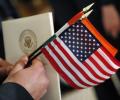
'When you think back to the promises made 10 years ago, not a single one of those had panned out to date.'
The new Obama Administration on Wednesday assured India that it will proceed with the landmark Indo-US nuclear deal, signed during George W Bush's tenure, and said the two countries needed to ramp up cooperation in counter-terrorism and global issues such as climate change.
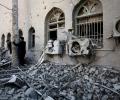
The logic of war plus the gathering storms in US politics as the midterms loom large leave him with no real alternative but to negotiate, points out Ambassador M K Bhadrakumar.
Canada will become the latest country with which India shall have civil nuclear deal since the Nuclear Suppliers Group (NSG) allowed New Delhi to resume global nuclear trade in September 2008.

US President Donald Trump on Thursday said that he has directed the country's Navy to take decisive action against any vessels attempting to lay mines in the strategically vital Strait of Hormuz amid escalating tension over the virtual control of the waterway between Tehran and Washington.

Iran's state broadcaster denies sending a diplomatic delegation to Pakistan for talks with the US, despite reports suggesting otherwise. This denial comes amid escalating tensions and aggressive rhetoric from Washington, even as signs of potential diplomatic movement emerge.
After four days of intense official level negotiations the two sides reached an understanding on a common text of 123 Agreement.

The US President clarified that these negotiations do not involve the new Supreme Leader, Mojtaba Khamenei.
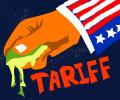
A trade deal makes sense only if it is fair and reciprocal. If the cost is strategic dependence or loss of policy space, waiting is the wiser option, asserts Ajay Srivastava.
Stressing India's commitment to the Indo-US nuclear deal, Sen said that the deal was mutually beneficial to both countries. He said that the deal was aimed and establishing a solid relationship between India and the United States in the long run. He also noted that the deal would only go through after discussions in both countries, and the deal would go through the democratic process.
